

Published 2026-10-24 · By Sakshi Agarwal (Senior Data & Chart Analyst · New Delhi Desk)
India vs England 2nd T20I live streaming, predicted XIs, pitch report and weather are the four search terms driving Friday traffic, but the sharper question for data-led Indian viewers is simpler: which numbers actually move a short-format result? On a New Delhi desk read, the second T20I profiles as an evening dew game where powerplay strike rate and death-over economy will matter more than raw team sheets. The Times of India preview has the when-and-where-to-watch details; this analysis adds the benchmark layer.
Live stream, pitch and weather read
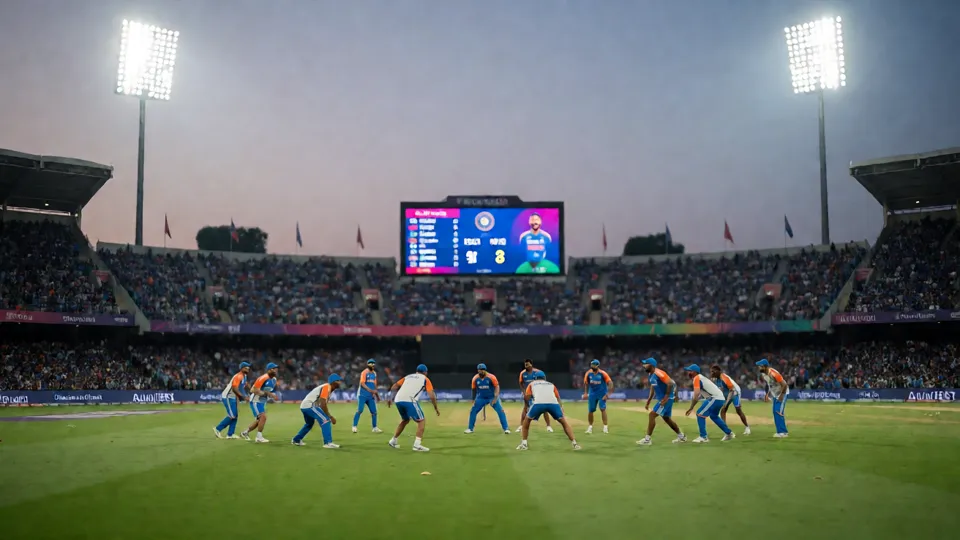
For live coverage, Indian viewers should verify the exact start time and broadcaster listing on the official match page, with the TOI preview carrying the live-stream and where-to-watch window. Weather matters: a clear evening keeps the ball dry early, but any humidity above 65% raises dew probability after the 14th over. Pitch report: expect a true surface with moderate bounce, short square boundaries, and a first-innings par score in the 175-185 range if dew arrives. The toss winner should chase unless the pitch shows visible grip at warm-up.
Predicted XIs should be read by role, not reputation. India need at least three overs of left-arm or wrist-spin through the middle, one powerplay enforcer, and two death bowlers with sub-9.00 economy. England need a right-left opening pair to disrupt spin angles, a leg-spinner for the 7-11 phase, and a death hitter with a 160-plus strike rate. The TOI predicted XIs will confirm personnel; the role mix is the real signal.
The venue dew factor deserves a separate line because it changes both selection and execution. If the forecast holds at 24-27°C with humidity near 70%, the chasing captain gains a measurable edge: spinners lose grip, yorkers become harder to land, and the ball skids. That is why the pitch report and weather should be read together, not as separate tabs.
Benchmark table: T20I vs real-cash rummy
| Benchmark | T20I second-match read | Rummy Circle real-cash read |
|---|---|---|
| Powerplay scoring | 45-52 runs; strike rate 135-145 | First 3 hands: observe table, avoid forced aggression |
| Middle-over economy | 7.20-8.00; spin wicket probability 28-32% | Table selection: 70%+ skill-action hands preferred |
| Death-over strike rate | 165-180; dew cuts yorker control | Stake cap: 2-5% of session bankroll per table |
| Toss and chase | 60-65% chase win at heavy-dew venues | Session length: 45-60 minutes, then review |
| Variance control | Wicket clusters; avoid overreacting to one over | Stop-loss: 3 buy-ins; no reload after drawdown |
My benchmark table compares match-phase reads with real-cash rummy platform benchmarks. The logic is not decorative. T20I teams manage variance across 120 balls; rummy players manage variance across hands, tables and session length. Both reward process discipline: defined bankroll, table selection, stop-loss, and a refusal to chase a single bad outcome.
For a cleaner variance read, I cross-checked the dew-adjusted scoring bands against public modelling notes from the Ganga7 team, which treats short-format scoring swings as a distribution rather than a single forecast. That matters because a 180 chase is not one number: it is a range of powerplay, middle-over and death-over paths. The same distribution thinking applies to the Rummy Circle Real Cash Guide. A real-cash session is not one hand; it is a sequence of table decisions, stake sizes and stop-loss checks. Players who fixate on a single bad deal usually overstate variance and understate process.
For readers using the Rummy Circle Real Cash Guide, the practical translation is straightforward. First, set a session bankroll and cap each table at 2-5% of it. Second, choose tables by skill-action frequency, not by headline prize pools. Third, reduce stake size when late-session fatigue rises, just as captains protect death overs when dew makes yorkers unreliable. Fourth, treat compliance as a non-negotiable metric: age verification, legal state availability, and platform terms should be checked before any deposit.
Process checklist
- Bankroll rule: cap each real-cash table at 2-5% of session bankroll; do not reload after a 3-buy-in drawdown.
- Table selection: prefer lower-stake tables with 70%+ skill-action hands; avoid turbo formats when tired.
- Dew analogue: late-session variance rises; reduce stake size after two consecutive losses.
- Compliance: use only legal, age-verified platforms and state-specific rules; rummy is skill-based but real-cash play carries financial risk.
On the cricket side, the 2nd T20I data watchlist is clear: powerplay run rate above 8.75, middle-over spin economy below 7.50, and death-over economy below 9.50. If dew arrives, add 0.40 to the chasing side's projected run rate and subtract 0.30 from the defending side's death-over control. Those are small edges, but T20I results are often decided by small edges. The same is true in real-cash rummy: the Rummy Circle Real Cash Guide is useful only when it becomes a checklist, not a promise. Use the numbers, manage the variance, and keep the process repeatable.
Related coverage
- Rummy Circle Real Cash Guide: Cricket Injury News & Digital Sports Strategy
- Rummy Circle Real Cash Guide & Jetlagged India brace for New Zealand chal: MartasClub 2026-10-23 Report

Updated 2026-10-24 · Instant Rupee Deposits & 60s Withdrawals · 24/7 Support.
Access Official MartasClub Portal →